November 18 update: Rockstar explains FSR 4 on Series S
In answers published by Wccftech, Rockstar now describes FSR Upscaling 4 on Xbox Series S. Our new article covers that explanation and its implications. The text below preserves the November 10 file report: its uncertainties reflect the evidence available then, and DLL names still cannot identify a running configuration by themselves.
The clue comes from two Xbox package filenames
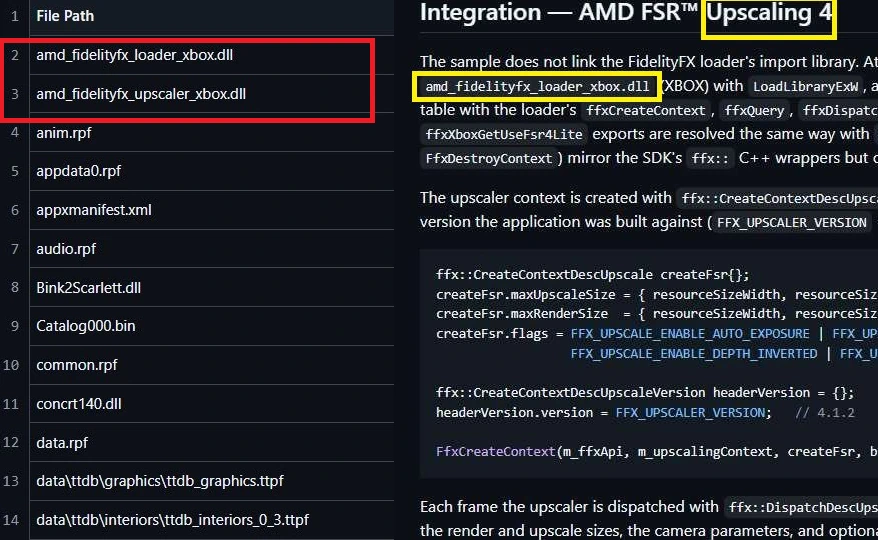
GTA 6 has a new Xbox graphics clue. VideoCardz reports two libraries attributed to the game package: amd_fidelityfx_loader_xbox.dll and amd_fidelityfx_upscaler_xbox.dll. The interesting part is not simply AMD’s name, but how they match the Xbox development-kit integration Microsoft uses to demonstrate FSR Upscaling 4.1.2.
The outlet traces the data to material shared by dataminer Tex2 and credits Y1ng and blue nugroho with comparing it against the documentation. That establishes the reporting chain: identify filenames, then look for matches in development tools. We distinguish that reported finding from what we could inspect directly in Microsoft’s public sample.
The match deserves attention because it offers a specific explanation for the libraries. A loader and an upscaler do not, however, identify GTA VI’s running configuration from their names alone. Understanding that distinction means looking at what the official integration supports.
FSR 4.1.2 has an official Series X and Series S integration
On November 4, AMD announced FSR Upscaling 4.1.2 for Xbox Series X|S through the October 2026 GDK. This is machine-learning image reconstruction. In practical terms, it works with a game’s rendered image to reconstruct a higher-resolution presentation while aiming to preserve the appearance of detail.
The Xbox implementation offers Full and Lite models, and AMD confirms both run on Series X and Series S. Lite reduces processing cost relative to Full. Developers choose the balance a title needs; that does not automatically assign Full to Series X and Lite to Series S.
That context matters when assessing older PC hardware requirements for FSR 4. Xbox’s current implementation uses INT8 models adapted to those consoles. AMD confirms this availability, which remains distinct from Rockstar choosing either model for GTA VI.
Our interpretation is that the interesting potential concerns detail during movement. With vehicles, vegetation and distant objects, it is useful to observe how contours hold together while turning the camera or driving. Those are things to examine in future comparisons, not GTA 6 improvements we have measured.
Microsoft’s sample explains why FSR 4 remains unconfirmed for the game
Microsoft documents the decisive qualification: its sample switches between FSR 4 Full, FSR 4 Lite and FSR 3 at runtime. The loader belongs to an integration that can work with different options. A filename associated with that infrastructure therefore cannot establish which one the game selects.
We verified that option in the public README, which describes provider selection and different running versions. The supported reading is that the reported files match FSR tools, while Rockstar’s active version and model remain open. The sample’s 4.1.2 identifier is the sample’s version; it does not automatically become an authenticated GTA VI version.
This is not frame-generation confirmation either. FSR encompasses multiple technologies, and AMD documents Frame Generation separately from upscaling. A loader and image-reconstruction library do not establish the creation of intermediate frames. Improving how an image is reconstructed and increasing displayed frame counts require different evidence.
The same applies to launch and hypothetical updates. Compatible tools may offer development options, but do not announce a future Rockstar decision. The documented match makes this worth following without turning it into a patch schedule or feature promise.
What this means alongside Rockstar’s official 30 FPS target
There is already an official performance reference: Rockstar sets a 30 FPS target in its November 10 announcement. The same post confirms PSSR and PS5 Pro-exclusive ray-traced shadows without detailing FSR on Xbox. This report adds an image-tools clue rather than replacing that target or announcing 60 FPS.
Judging its effect will require commercial-version comparisons in equivalent scenes and moving footage. We will want to inspect detail while driving, trails around moving objects and image behaviour as lighting changes. Comparing an FSR label with a PSSR label cannot choose a winner without observing their implementations.
Existing Series X and Series S owners can follow official details and prepare for launch. The documentation establishes that both consoles have access to this technology through development tools, rather than establishing GTA VI’s choice. A Rockstar explanation or verifiable commercial-release analysis could turn the filename match into a conclusion about the actual playing image.
Sources & editorial notes
Reviewed November 10, 2026. We read VideoCardz’s report and checked the integration against AMD’s announcement and Microsoft’s public sample. GTA VI package filenames come from the report, which cites Tex2, Y1ng and blue nugroho; we have not extracted or authenticated the game package. The comparison image is attributed to blue nugroho and VideoCardz, rather than presented as our own test. Original AI-generated editorial cover, not gameplay or a benchmark. The 30 FPS target and PS5 Pro features come from Rockstar’s official announcement on the same date.
Wccftech · Respuestas de Rockstar sobre FSR 4 en Series S ↗VideoCardz · GTA VI Xbox files match AMD FSR 4.1.2 GDK integration ↗AMD GPUOpen · FSR Upscaling 4.1.2 para Xbox ↗Microsoft · Muestra oficial AMD FSR para GDK ↗AMD GPUOpen · FSR Frame Generation ↗Rockstar · Objetivo de 30 FPS y precarga disponible ↗Read our editorial standards